Thursday, January 24, 2008

Xiu Xiu's Influence

If I were a young Chinese girl (born in 1975 in Beijing) who was confronted with the Tiananmen Square demonstrations after hearing Xiu Xiu's story, how would I react?
Xiu Xiu's generation grew up in the 1960s, in the midst of the Cultural Revolution. The film shows how idealistic young people soaked up the ideals of the revolution. Waving Mao's little red books and singing revolutionary songs, youth like Xiu Xiu seemed feverish to want to break with old traditions, old customs and old behaviour, to move China into the glorious future promised by Mao. Before Xiu Xiu understood the reality of the re-education campaign, she and her friends were excited about being send to the countryside, they board the buses laughing and full of expectaqtions. When my generation was born, the Cultural Revolution was dead and by the time I became a teenager, Mao was dead and Deng Xiaoping was beginning to reform China's economy and opened a window to the West.
In 1989, when students questioned the high unemployment rate that Deng's modernization of the unprofitable state-run businesses brought, the rapidly increasing cost of living and high corruption among party members, I would have been thirteen, just a little younger then Xiu Xiu. I think that the idealism of Xiu Xiu's generation had evaporated and many young people of my age were looking to the consumerism of the West. Had I been a little older and experienced more of the aftermath of the Cultural Revolution, I believe I would have joined the students' demonstrations. But as a 13-year old I don't think I would have had the political knowledge, experience and drive to participate. Xiu Xiu's story probably would have seemed utterly old-fashioned, a morality tale I would not have understood. I would not have understood how the reality of re-education, the removal from everything Xiu Xiu had ever known and had loved (the cultural amenities of city live, her family, her dreams), her experiences of corruption and isolation, could change a young girl to the point where she sees no way out but death.

Sunday, January 20, 2008


The film The Official Story has an open ending:

What will happen not only to Alicia's family but also where will the country go? What is done to bring justice to the families of the disappeared? In the two decades following the "dirty war" of 1976-1983 the new Argentine government created amnesty laws that protected the junta leaders from prosecution. In 2003 the government voted to overturn the amnesty and in 2005 Argentine's Supreme Court found the amnesty laws to be in violation of the Argentine constitution. How will this decision affect those junta members that were pardonned earlier under the amnesty law? Those responsible for the 30,000 disappearances will likely never be sentences for their crimes; many are in the 70's and older. Ditto for the non-Argentine nationals that have been implicated in the dirty war. Declassified documents from the U.S. State Department showed that Henry Kissinger, Dick Cheney and Rumsfeld supported the military regime in Argentine.
For the familie who lost 30,000 members and who, like the Abuelas de Plaza de Mayo have been seeking justice for decades now, this political limbo must be infuriating! The grandmothers are continuing their work. Only 77 missing children have located. New laws and technology may make it easier to identify the children; national law has created a Genetic Data Bank that stores the genetic material from all families that have come forwards.


Saturday, January 5, 2008

The Year of Living Dangerously


The Year of Living Dangerously Lobbycard Set
http://en.wikipedia.org/wiki/The_Year_of_Living_Dangerously

Djakarta, Indonesia, June 1965

Guy Hamilton (Mel Gibson), an Australian journalist, arrives in Djakarta unprepared and without contacts. Billy Kwan (Linda Hunt), a photographer familiar with Indonesia and the political climate, takes Hamilton under his wings as he has done with Jill Bryant (Sigourney Weaver) and other foreign journalists. Smitten with Hamilton's determination, lust for action and danger, Billy introduces Hamilton to Jill who holds a post at the British Embassy and is equally enthralled with change and adventure. Of course the two fall for each other (I guess movies without romance and sex don't sell well). When the Embassy receives a coded message that a load of weapons are on the way to the PKI (Communist Party of Indonesia) Jill shares the news with Guy, hoping to entice him to leave before the start of the civil war. Guy, however, sees the possibilities the messages opens up for him as a journalist and as an adventurist. Despite the fact that following the lead could endanger Jill, he picks up the story and investigates. As the events of the 1965 coup unfold through the eyes of Guy Hamilton, the different film characters relay the sides of the conflict to the viewer.

Through Billy Kwan's eyes we see Indonesian President Sukarno. Sukarno, who has been president since 1947, not only liberated the country from the Netherlands but also managed to unite a country that is spread out over 17,000 islands and is home to many ethnic and religious groups. As Billy remarks, however, in his attempt under Guided Democracy to please and unite the different fractions, Sukarno lost his reputation and turned to empty speeches. Scenes from the film show great poverty while officials live lavishly. In the end, Billy is murdered by security forces as he displayes an anti-Sukarno banner from his hotel.

Kumar, the PKI official introduced to Guy by Billy, shows Guy the situation from PKI perspective. "My country suffers under great poverty and corruption. Is it wrong to want to change?" When Guy wants to know if his loyality to the PKI will continue when the fighting and killing starts, Kumar simply states that sometimes there's no other way. Like Billy, Kumar has taken a liking to Guy and seems to protect him.

In the end the coup falls, the PKI looses and Sukarno is still in power. Although able to stay, Guy decides to leave Indonesia.

I have not quite decided how to interpret Billy Kwan. Played by Linda Hunt, he comes across as a person who bends gender lines and likes to direct and manage people. Compassionate about the people of Indonesia, Billy attempts to spread his compassion to Guy. At first I actually thought Billy was female. Vincent Canby, NY Times, writes "It's Billy's fate to play God, and gods are, if not androgynous, then not necessarily condemned to a single sexual identity." http://movies.nytimes.com/movie/review?res=9951A0C0173BF932A35750C8BF67.

Wednesday, December 26, 2007


After watching Earth I remembered last year's headlines about the inaugural Lahore-Amritsar bus that in January 2006 re-linked for the first time the Punjab region which was divided into Eastern/Indian Punjab and Western/Pakistan Punjab during India's partion 60 years ago. http://news.bbc.co.uk/2/hi/south_asia/4630726.stm

Tuesday, December 25, 2007

C.J.S Wallia's Review of Earth

Unfortunately C.J.S. Wallia’s review for IndiaStar was the only review I could link to.
The author perceived the film as weak, with undeveloped characters and historically inaccurate. Leaving aside the accusation that Earth “distorts the historical role of the Sikhs” during India’s partition (an opinion that I can neither accept or dispute as I don’t know enough about the Sikhs), I do feel that the characters were purposely shallow and somewhat superficial.
As Wallia writes, the film tells the story of the 1947 events from the perspective of Lenny, the young girl better known as Lenny Baby in the movie. Lenny's family are well-to-do Parsees who keep up the Parsee tradition of remaining neutral or, as Lenny’s mother describes, invisible. Until the tragedy hits their home, the family cloaks itself oblivion. Through her ayah (nanny) Shanta, Lenny becomes confronted with what is happening as India enters independence and is seemingly arbitrarily divided by Britain into Pakistan and India. As Hasan describes, the large religious groups in India – Hindus, Muslims and Sikhs – have lived together for centuries like “brothers”, sharing their language, food and enemies. But on the eve of independence and Indian partition, Hindus, Muslims and Sikhs are beginning to keep to themselves and are trying to find blame with each other for the new developments.
From the view of an eight-year old Parsee girls and her family, who desperately try to stay neutral and distance themselves from the events, the Muslims and Sikhs that form Shanta’s clique are feverish, simple and stereotypical. The family simply would not know enough about the Sikh Sher Singh, the Muslim Ice-Candy Man Dil Navaz and the Hindu masseur Hasan to see these characters in their complexity. Thus during the few times when Lenny accompanies Shanta to the group’s gatherings, the characters are trimmed down to religious stereotypes: warrior Sikhs (“bloody nuisances)and religiously righteous Muslims (“we’ll put the fear of God up your Hindu trousers”). Solely Hasan, a Hindu who is progressive, diplomatic and tolerant much like Lenny's family, is seen as more complex.
Overall, I did not feel that it was the film's purpose to teach the viewer history of India's independence and partition, rather the film wants the viewer to look inside and see how far she/he would be willing to stay neutral and apolitical. I think that's question we all should ask ourselves today.

Friday, December 21, 2007

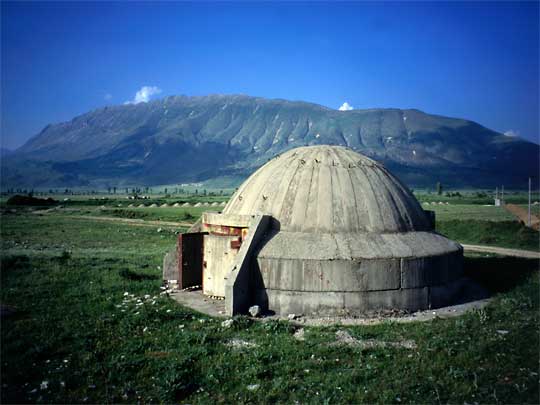
Rebuilding Albania


Link to 2001 BBC article on Albania:
Amazing what can be achieved in ten years! The description of the early 1990s Albania in this article reflects many scenes of L'America! Another interesting bit: Albania is one of the few countries that enthusiastically welcomed and cheered George W. Bush during his Summer 2007 European tour!

Thursday, December 20, 2007

After my dad's death two years ago, my siblings and I found a box of long forgotten 8 mm films. We set up the old projector and screen and for a few hours relived highlights of summer vacations. My dad, a quite unsentimental intellectual, had perfected a filming method that he repeated over and over again: Line up the family in front of a historic land mark and then capture everyone walking and waving towards the camera. In doing so he captured much that no longer exists or has been forgotten: the Berlin Wall, the empty streets of East Berlin, the burned out Reichstag, border crossings into Belgium, the (then) Yugoslavia coast... The films were a bit repetitive but it was fun to see ourselves grow in front of my dad's camera and to reminisce changes in our family and in Europe. I think watching some of the films for this class, especially those set in the Balkans, will trigger other forgotten events.